Japan Is Moving AI Risk Into the Emergency Room
Japan’s latest AI move is easy to misread if you file every policy under “AI governance.” This one belongs somewhere harsher.
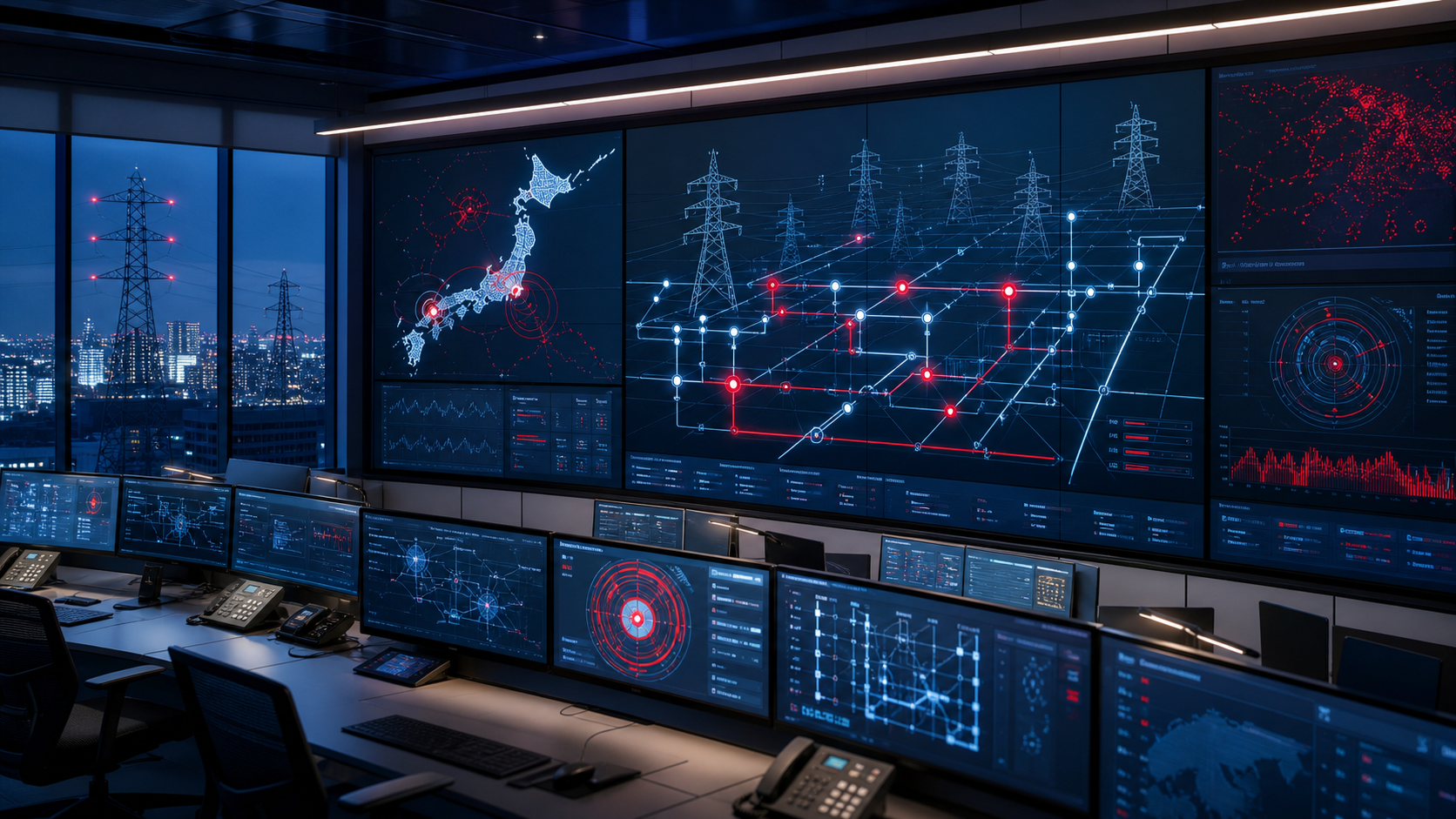
The Ministry of Economy, Trade and Industry on May 1 convened five critical-infrastructure sectors around systems that could be affected by high-performance AI. The meeting covered electricity, gas, credit, chemicals, and oil operators. METI asked the sectors to align on immediate responses, and it specifically asked major electricity operators to confirm their IT assets and status, then report back within roughly one month. METI framed the risk plainly: advanced AI is making vulnerability discovery easier and faster, which raises the odds that weaknesses in important systems become exploitable before operators have treated them as urgent.
That is not ordinary model policy. It is a public-safety posture.
Japan is no longer asking only whether developers disclose, label, watermark, or risk-assess AI systems. It is asking whether the companies that keep power, fuel, credit, and industrial chemicals moving can absorb the security consequences of better attack tooling. The subject is AI. The control surface is infrastructure.
The Problem
Japan has been careful not to turn AI policy into a maximalist licensing regime. Its new AI law, passed by the House of Councillors on May 28 according to The Japan Times, was built around government strategy, research promotion, and investigation of serious misuse rather than Europe-style ex ante product regulation. That approach fits Japan’s industrial priorities. It wants AI adoption inside factories, robotics, public services, and infrastructure. It does not want paperwork to become the product.
The METI request shows the limit of that frame.
High-performance AI changes cyber defense before it changes the legal taxonomy of models. It lowers the cost of scanning code, finding known-but-unpatched exposures, generating exploit variants, writing phishing infrastructure, and automating the boring work that turns a theoretical vulnerability into an operational incident. Critical infrastructure operators do not get to wait for an AI governance office to finish a classification matrix. They have dispatch systems, billing systems, plant operations, customer databases, supplier access, remote maintenance paths, and incident playbooks.
METI’s May 1 language is narrow but revealing. The ministry did not publish a broad AI ethics checklist. It convened a joint meeting between cybersecurity and critical-infrastructure policy officials, asked the five METI-supervised sectors to share an immediate risk posture, and singled out major electricity operators for asset/status confirmation and a roughly one-month report. The trigger was not model opacity. It was the risk that AI accelerates vulnerability identification against essential services.
That difference matters.
The Analysis
The covered sectors tell the story. Electricity and gas are obvious because energy outages cascade. Oil matters because fuel logistics and refining interruptions move quickly from enterprise disruption to national resilience. Chemicals are dangerous because cyber incidents can collide with physical process risk. Credit is different but just as important: payment, lending, and settlement disruption can convert a security failure into an economic confidence problem.
Japan’s National Center of Incident Readiness and Strategy for Cybersecurity already treats critical infrastructure as a broad resilience domain. Its critical-infrastructure policy page points to the country’s action plan and safety-standard guidance, which cover fifteen infrastructure fields and organize policy around preventing outages, responding to incidents, and maintaining service continuity. The May 1 action is smaller than that full framework. It is an urgent convening of five METI-related sectors inside the larger national apparatus, with the hardest near-term reporting ask directed at major power operators.
That means the obligations are not best understood as a new binding AI rule. They are closer to emergency supervisory pressure: inspect now, look specifically for AI-amplified vulnerability risk, and report or act through existing critical-infrastructure security channels. The enforcement force comes less from a new AI statute than from sectoral oversight, incident-response expectations, and the fact that these firms already sit inside Japan’s critical-infrastructure regime.
The cabinet follow-through made the posture clearer. On May 12, Jiji Press reported via Nippon.com that Prime Minister Sanae Takaichi instructed ministers to prepare guidelines on cyberattack preparations using AI. The report said Japan would strengthen defensive systems against increasingly sophisticated cyberattacks as generative AI spreads. That is the same logic as METI’s request, lifted from sector inspection into national preparation.
There is a useful awkwardness here. AI policy is usually organized around who builds or deploys AI. Critical-infrastructure security is organized around what cannot be allowed to fail. Japan is letting the second logic dominate.
That is the right choice.
The practical risk is not that an electricity utility suddenly becomes an AI developer. The risk is that attackers use AI to compress the reconnaissance-to-exploitation cycle while the utility’s patching, vendor-risk, network segmentation, identity controls, backup testing, and incident exercises still move at administrative speed. AI does not need to be inside the control room to change the risk of the control room. It only needs to improve the attacker’s workflow.
The same is true in credit. A bank or credit-card operator may already have fraud models, chatbots, and customer-service automation. But the critical-infrastructure question is more basic: can the institution keep payment and credit functions operating when adversaries use AI to scale credential attacks, find exposed systems, imitate counterparties, or automate vulnerability chaining across vendors?
That is why this is infrastructure security rather than chatbot policy. The relevant failure mode is not a bad answer from a model. It is outage, manipulation, extortion, or loss of operational confidence in essential services.
The Implications
Japan’s move is a preview of where AI regulation is likely to harden first.
The most aggressive rules may not start with general-purpose model licensing. They may start with sector supervisors telling essential-service operators to treat AI as a new threat multiplier inside existing resilience duties. That route is faster. It avoids abstract fights over model definitions. It also reaches the systems that citizens notice when they fail.
For operators, the lesson is uncomfortable. A generic AI policy will not satisfy this posture. A company needs a security answer: asset inventory, exposed-service review, patch latency, vendor access controls, identity hardening, phishing resistance, incident escalation, backup recovery, tabletop exercises, and evidence that AI-assisted vulnerability discovery has been considered in threat modeling.
For AI companies, the lesson is also blunt. Even when the regulation is not aimed directly at them, their tools are becoming part of the assumptions used by infrastructure supervisors. Better models raise the baseline capability of defenders and attackers. Governments will increasingly ask operators to prove they understand that dual-use shift.
Japan’s approach still has gaps. A request can produce uneven compliance. Sector-by-sector action can miss cross-sector dependencies, especially where cloud, telecom, software vendors, and managed service providers sit between regulated operators and real-world systems. Guidance can also age badly if it is written as a document rather than built into recurring tests.
But the strategic direction is sound. Japan is not treating AI risk as a seminar topic. It is moving it into emergency convening, sector supervision, electricity-sector asset review, and cyber-preparedness planning.
That is where the AI governance debate gets less elegant and more useful. The question stops being whether a model is scary in the abstract. It becomes whether the grid, fuel chain, payment rail, chemical plant, and operator on call at 2 a.m. can survive what better automation lets attackers do next.


Discussion
Sign in to join the discussion.
No comments yet. Be the first to share your thoughts.