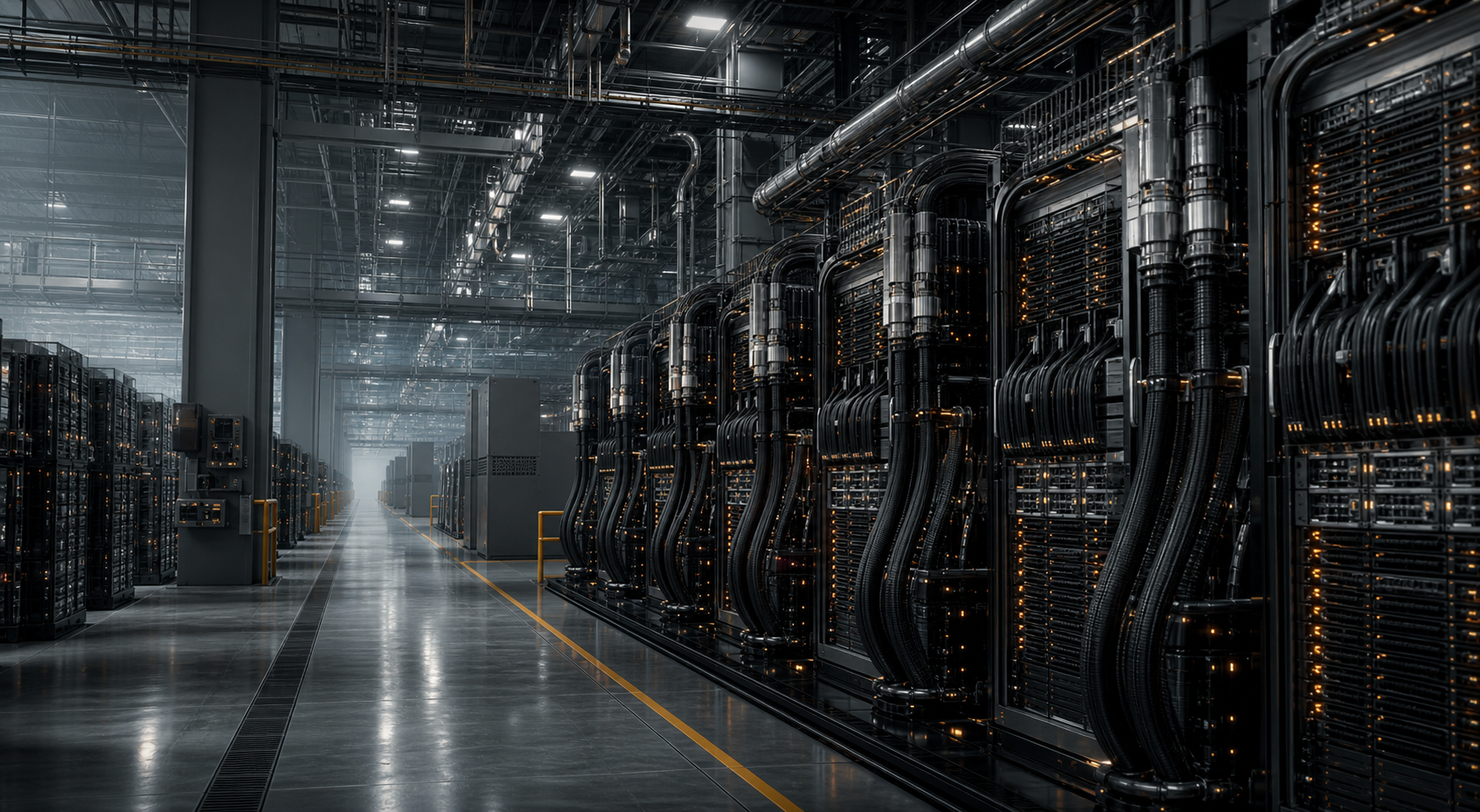
CoreWeave’s first quarter looked strong enough to end the discussion. Revenue reached $2.078 billion, up 112% year over year and 32% sequentially. Backlog climbed to $99.4 billion. Management said it added more than $40 billion of new commitments in the quarter and now has 10 customers committed to spending at least $1 billion.
But CoreWeave’s Q1 disclosures complicate the picture. The question is not whether demand exists. It does. The question is whether GPU cloud lessors still behave like scarcity landlords, or whether they are turning into synthetic hyperscalers: giant contracted demand, giant financing needs, and margins that compress before utilization does.
CoreWeave’s Q1 argues for the second model.
The Analysis
Start with gross margin. CoreWeave reported $716 million of cost of revenue on $2.078 billion of Q1 revenue. That implies gross margin of roughly 65.5%. Still high. Also still down from roughly 67.6% in Q4 2025 and about 73.3% in Q1 2025.
That decline would be easier to explain if pricing were soft. Management said the opposite. On the earnings call, CoreWeave said average pricing for A100s, H100s, H200s, and L40s increased quarter over quarter, and that near-term fleet capacity remains largely sold out.
So this is not a price-collapse story. It is a scaling-cost story.
The operating line says the same thing more bluntly. Adjusted operating income fell to $21 million, or a 1% margin, in Q1 2026, down from $88 million, or 6%, in Q4 2025. Demand did not fade. Economics got heavier.
The balance sheet explains why. Net interest expense rose to $536 million in Q1, up from $388 million in Q4 2025 and $264 million in Q1 2025. Net cash used in investing activities reached $7.7 billion. Full-year 2026 capex guidance is $31 billion to $35 billion, with $7 billion to $9 billion of Q2 capex.
That is hyperscaler math. The company may rent GPUs, but it is financing power, land, networking, and build schedules like a cloud platform that expects to stay huge for a long time.
That distinction matters because hyperscalers can usually spread those fixed costs across broader software, cloud, and enterprise revenue pools. CoreWeave cannot. Its business is much more concentrated around frontier-compute demand. If that demand stays strong, the model works. If buying patterns slip, or if major customers squeeze pricing later from a stronger negotiating position, the capital structure leaves less room for error than the backlog headline suggests.
Customer concentration is still the other structural tell. CoreWeave disclosed that 65% of Q1 2026 revenue came from its top two customers. That is better than Q1 2025, when 72% came from the top customer alone. It is not broad diversification. It is concentration widening from one frontier-scale buyer to two. The same filing points to Meta’s roughly $21 billion order form signed in March 2026, while OpenAI also remains central to the demand picture.
Then there is backlog quality. The $99.4 billion backlog gives CoreWeave real visibility, but the 10-Q says only 36% of unsatisfied remaining performance obligations are expected to be recognized by March 31, 2028. That is the awkward part of the model. Capital goes out fast. Revenue comes back on a longer fuse.
Guidance reinforces that mismatch. Q2 revenue is guided to $2.45 billion to $2.60 billion, which supports the utilization story. But Q2 interest expense is also guided to $650 million to $730 million. When pricing is rising and capacity is sold out, yet the interest bill keeps inflating, the bottleneck is not weak demand. It is the cost of building a hyperscaler before the income statement is ready for one.
That financing point matters more than one quarter of GAAP noise. A company that can stay sold out and still watch financing costs rise this quickly is telling investors where the future pressure will show up first. Not in empty racks. In the spread between booked demand and the cost of making that demand physically deliverable.
The Implications
The simple version of the CoreWeave story is that it is a GPU landlord with elite demand. Q1 points somewhere harsher. CoreWeave is becoming a hyperscaler before it has hyperscaler economics.
That does not make the quarter bearish by default. The demand is real. The backlog is real. The company says it has more than 3.5 gigawatts of contracted power and expects more than 1.7 gigawatts of active power by year-end 2026. Buyers are not the problem. The burden is financing and delivering infrastructure at a pace that makes traditional cloud capex cycles look almost restrained.
That is the real read on the quarter. The margin debate is no longer about whether leased GPU pricing is weakening. CoreWeave’s own disclosures argue the opposite. The live question is whether an independent AI cloud can carry hyperscaler-scale debt, build commitments, and customer concentration without converging toward hyperscaler-style returns.
Q1 did not settle that question. It made it impossible to ignore.


Discussion
Sign in to join the discussion.
No comments yet. Be the first to share your thoughts.