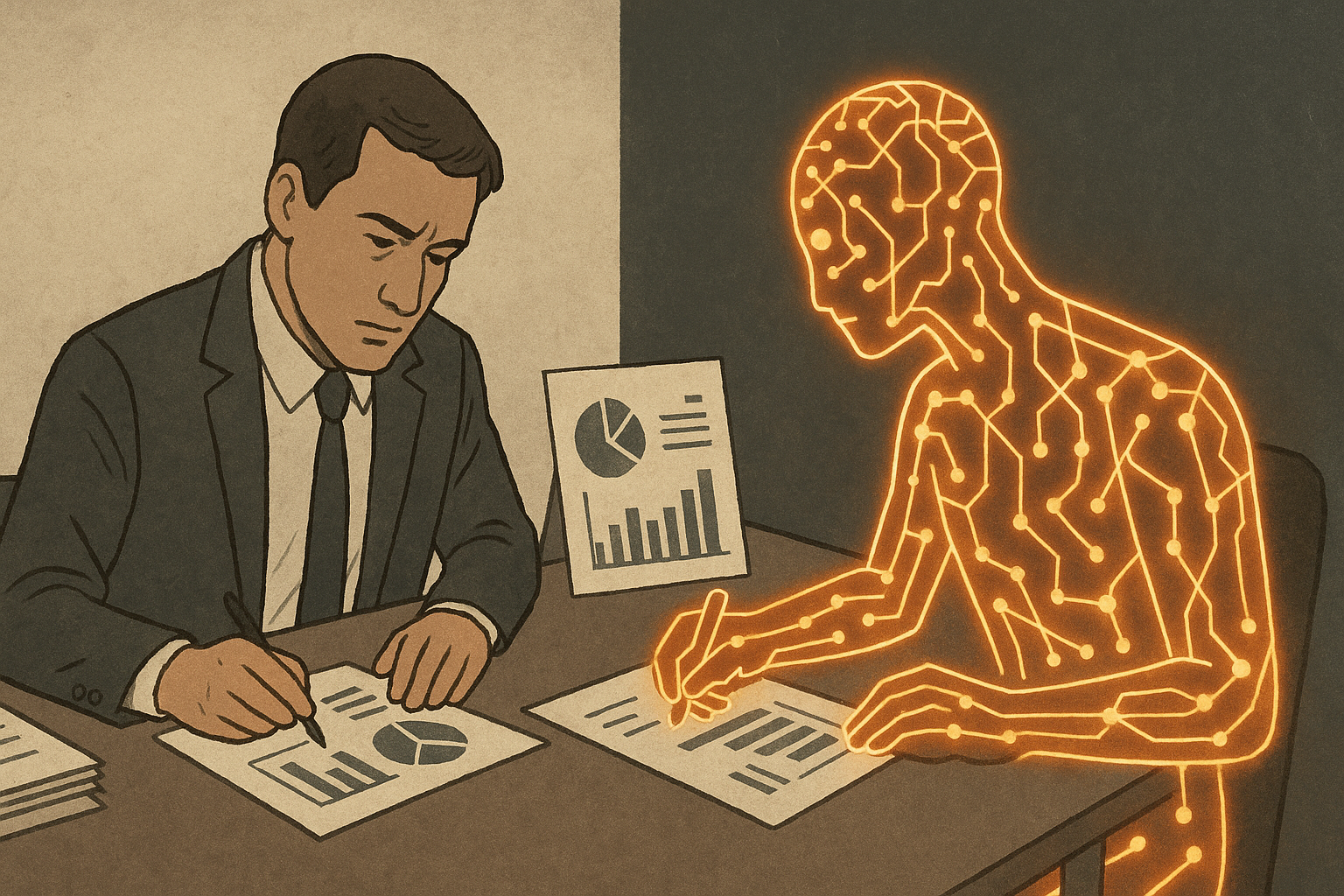
The question of whether AI will take jobs has been asked in every technology wave since the Luddites. The answer has always been the same: yes, and new jobs emerge to replace them. Economists call this the lump of labour fallacy — the mistaken belief that there is a fixed amount of work to be done. Technology expands the pie.
I believe this is true historically. I am also increasingly convinced it is the wrong frame for what is happening now.
The optimists are right that productivity gains are coming. The problem is the speed.
Past technological displacement happened over decades. Steam looms disrupted handloom weavers across a generation. Office automation took twenty years to reshape clerical work. Workers could retrain, industries could absorb, governments could adapt policy frameworks. The time lag between displacement and adaptation was brutal, but it existed.
Generative AI is compressing that lag to years — possibly months for particular skill clusters. Entry-level financial analysis, basic code review, legal document summarization, first-draft copywriting: these are all categories where cost-per-output is already falling 60–80%.
This does not mean permanent mass unemployment. It does mean that the usual reassurance — “technology has always created as many jobs as it destroys” — provides no comfort to the 26-year-old financial analyst whose employer has cut its graduate intake by 40% while senior headcount stays flat.
Historical averages are cold comfort when you are on the wrong side of the discontinuity.
The optimists may well be right in the long run. But “the long run” has always been a way of not answering the question that actually matters: what happens to the people who are in the wrong place in the wrong decade? That question deserves more than historical analogies.


Discussion
Sign in to join the discussion.
No comments yet. Be the first to share your thoughts.