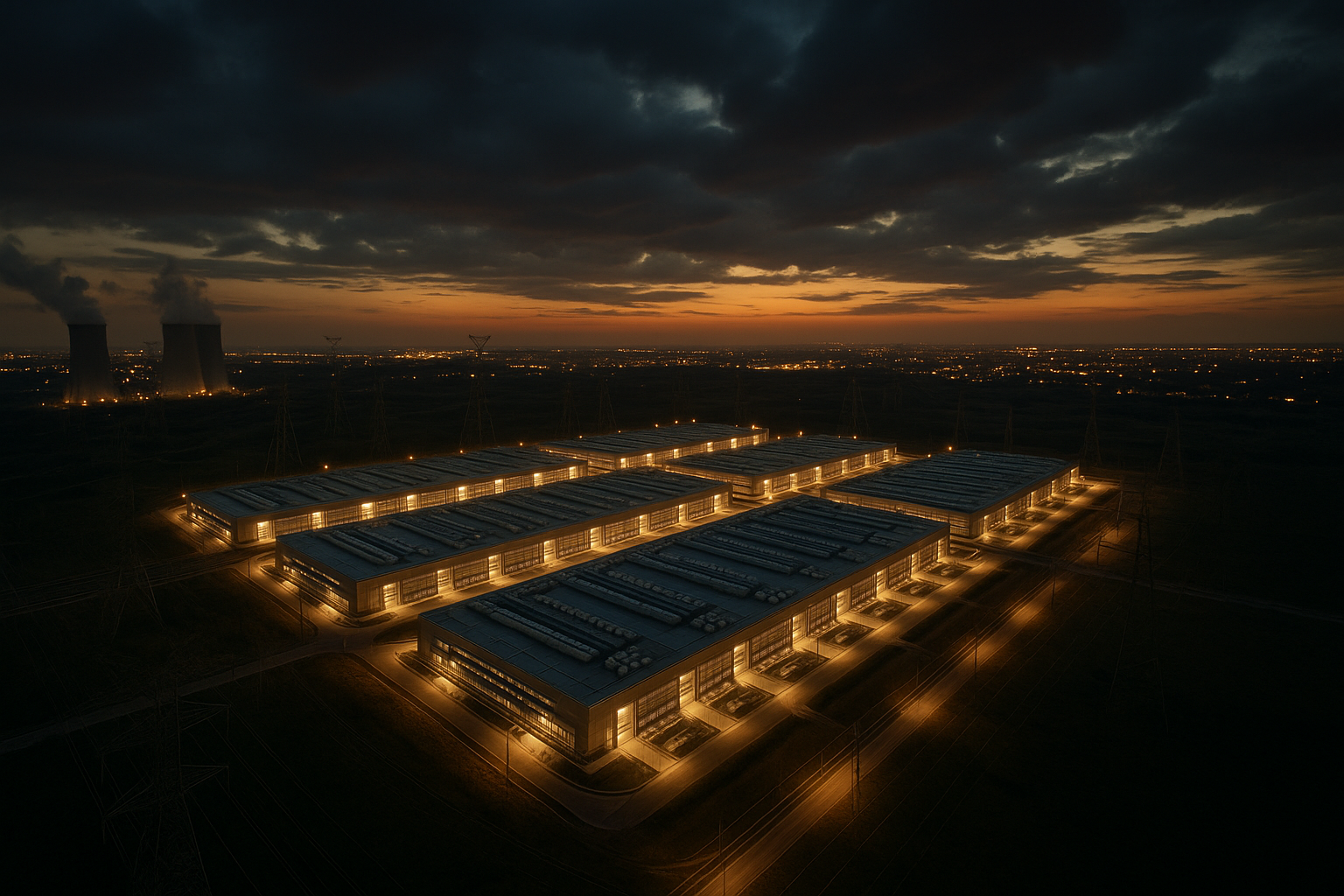
The quiet crisis at the heart of the AI revolution has a very mundane name: the kilowatt-hour. As the world's appetite for large language models, image generators, and real-time AI inference has exploded, the physical infrastructure powering that computation is colliding with national electricity grids in ways policymakers are only beginning to confront.
A Consumption Curve That Confounds Forecasters
Data centers consumed an estimated 415 terawatt-hours of electricity globally in 2025, according to the International Energy Agency—roughly equivalent to France's entire annual power output. The IEA now projects that figure will nearly double to 800 TWh by 2028, driven primarily by AI workloads. In the United States alone, data center electricity demand is on track to represent 9 percent of national grid consumption by 2027, up from approximately 4 percent in 2022.
The acceleration has caught grid operators off-footed. Northern Virginia—home to the world's densest concentration of data centers, accounting for roughly 70 percent of global internet traffic routing at peak—is experiencing transmission congestion that utilities warn could require $2.5 billion in grid upgrades over the next five years (Dominion Energy, Q1 2026 regulatory filing). New data center connection requests in the region now face wait times of up to seven years.
The Moratorium Belt
Some governments have hit the brake. Singapore imposed a data center capacity moratorium from 2019 to 2022, then reinstated growth controls in 2025 after power demand projections exceeded grid expansion timelines. Ireland—which hosts European operations for Microsoft, Amazon, Google, and Meta—warned in March 2026 that data centers could consume up to 32 percent of national electricity by 2030 (EirGrid, National Demand Forecast 2026). Dublin has paused new large-scale approvals in grid-constrained zones while the government develops an AI infrastructure framework expected in Q3 2026.
The Netherlands, which hosts one of Europe's largest internet exchange points, enacted its own density controls in 2023 and has since redirected hyperscaler interest toward regions with surplus renewable capacity, including Scotland and Scandinavia.
Nuclear and the Race for Always-On Power
In response, the hyperscalers have turned to nuclear power with unusual urgency. Microsoft's agreement to restart a unit at Three Mile Island—finalized in late 2024 and now delivering 835 megawatts to the PJM grid—set the template. Amazon followed with a 960 MW deal with Constellation Energy in early 2025. Google has signed agreements for small modular reactor capacity from Kairos Power, with first output projected for 2030.
The logic is straightforward: AI inference requires continuous, uninterrupted power that solar and wind alone cannot guarantee. Nuclear's 90-percent-plus capacity factor makes it uniquely suited to the task. At current capital cost projections, analysts at BloombergNEF estimate SMR-sourced electricity will cost $120–$180 per MWh at point of delivery—roughly triple current wholesale rates in most markets.
A New Axis of Competition
The emerging geography of AI compute is not purely technical. Nations with cheap, abundant power—Canada, Norway, Iceland, and parts of the Gulf Cooperation Council—are actively courting hyperscaler investment as a GDP lever. Saudi Arabia's Public Investment Fund has committed $100 billion to AI infrastructure through 2030, targeting 25 data center campuses on the basis of low-cost gas-fired generation combined with rapidly expanding solar capacity.
Meanwhile, countries without that energy advantage risk ceding AI infrastructure sovereignty entirely. The result is a new axis of geopolitical competition: not just chip exports and model access, but electrons. The nations that control the power will increasingly control where the world's AI runs—and who gets to use it.


Discussion
Sign in to join the discussion.
No comments yet. Be the first to share your thoughts.